
Crawl Space Dehumidifiers: What Works in Fort Mill and Charlotte Homes

Mateo Alvarez • March 18, 2026

If you have a crawlspace under your home, moisture control isn't optional — it's structural. In the Fort Mill, Rock Hill, and greater Charlotte area, crawlspace humidity is one of the most consistent drivers of wood rot, mold growth, and indoor air quality problems we see. The clay-heavy Piedmont soil holds water rather than draining it. Summer humidity in York County regularly exceeds 70 percent. Ground moisture moves upward through the soil and vapor barrier constantly during warm months.

A crawlspace dehumidifier is one of the most important components of a properly managed crawlspace — but only when it's the right unit, properly sized, correctly installed, and maintained. This guide explains what separates an effective crawlspace dehumidifier from a wasted purchase, what installation involves, and when dehumidification alone isn't enough.

Why Standard Home Dehumidifiers Don't Work in Crawlspaces

This is the first thing most homeowners get wrong. A portable home dehumidifier from a hardware store — the kind you'd put in a basement or laundry room — is not designed for crawlspace use. These units operate at temperatures above 65 degrees Fahrenheit. Crawlspaces in the Carolinas regularly drop below that threshold in fall, winter, and early spring, causing the coils to ice over and the unit to stop working entirely. The unit runs, consumes electricity, and does nothing to control moisture.

Crawlspace-rated dehumidifiers are built differently. They use hot gas defrost systems that allow operation at temperatures as low as 35 to 40 degrees Fahrenheit. They're designed to run in low clearance environments, to drain continuously through a condensate line rather than requiring manual emptying, and to move higher volumes of air than residential units. They carry an AHAM (Association of Home Appliance Manufacturers) rating for moisture removal at conditions that actually exist in a Carolina crawlspace — typically 80 degrees and 60 percent relative humidity — rather than the inflated lab conditions used to rate residential units.

The most widely used crawlspace-rated units in the region are made by companies like Aprilaire, Santa Fe, and Dri-Eaz. A properly sized unit for a typical Fort Mill crawlspace — 1,000 to 1,500 square feet — will remove 70 to 90 pints of moisture per day under peak summer conditions. A hardware store dehumidifier rated at the same number of pints will remove a fraction of that under real-world conditions, if it runs at all.

Sizing: The Most Common Installation Mistake

Undersizing is the most frequent mistake we see on crawlspace dehumidifier installations — and it's almost always the result of using the unit's rated capacity rather than its effective capacity under actual crawlspace conditions.

Proper sizing starts with the square footage of the crawlspace, but it doesn't end there. The moisture load in a Fort Mill or Rock Hill crawlspace depends on several factors: whether the crawlspace is fully encapsulated or has open vents, the depth of the crawlspace and volume of air it contains, the soil type and water table depth at the property, the number of foundation vents and their current state, whether there are any known water intrusion points, and the HVAC equipment and ductwork present in the crawlspace.

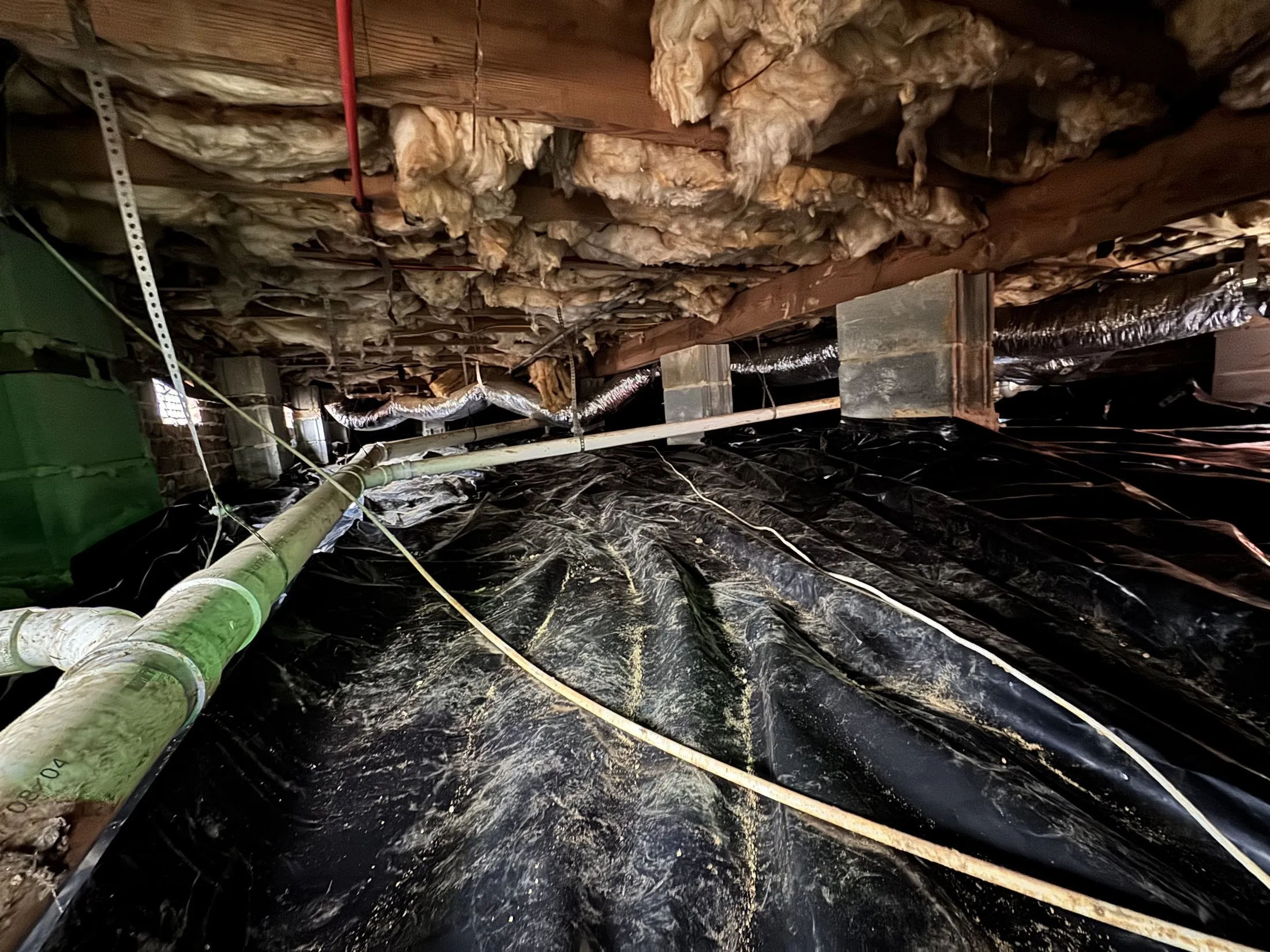
A vented crawlspace — one with open foundation vents — has a dramatically higher moisture load than a sealed, encapsulated crawlspace. In a vented crawlspace in July in Fort Mill, you're fighting the entire outdoor humidity load constantly. In a properly encapsulated crawlspace, the dehumidifier only needs to manage ground vapor transmission and incidental moisture. The unit that's right for one scenario is badly undersized for the other.

As a general guideline, a properly encapsulated crawlspace of 1,000 to 1,500 square feet in this climate typically requires a unit rated at 70 pints per day at crawlspace conditions (not lab conditions). A vented or partially open crawlspace of the same size may require 90 pints or more. When in doubt, size up — an oversized unit will cycle on and off as needed, while an undersized unit will run continuously, wear out faster, and still fail to maintain target humidity levels.

What Proper Installation Involves

Dropping a dehumidifier into a crawlspace and plugging it in is not installation. Proper installation in a Fort Mill or Charlotte area crawlspace involves several components that determine whether the unit actually does what it's supposed to do.

Continuous condensate drainage. Crawlspace dehumidifiers collect significant volumes of water — up to 90 pints per day under peak conditions. That water has to go somewhere. A properly installed unit drains continuously through a condensate line routed to either a floor drain, a sump pump pit, or outside the crawlspace perimeter. Units that drain into a bucket or collection pan will fill and shut off within hours during summer. Every installation we do includes a properly sloped, continuously draining condensate line.

Correct placement for air circulation. A dehumidifier works by pulling air through its coils, removing moisture, and exhausting drier air back into the space. If the unit is tucked into a corner or blocked by equipment, pipes, or structural elements, its effective coverage drops significantly. For larger crawlspaces, placement is calculated to maximize air circulation through the entire space — sometimes with supplemental air circulation fans.

Dedicated electrical circuit. Crawlspace dehumidifiers draw significant power — typically 5 to 8 amps continuously. Running one on a shared circuit with other loads risks tripping breakers and leaving the crawlspace unprotected. A dedicated 20-amp circuit is standard for crawlspace dehumidifier installation in this region.

Target humidity setting. The unit should be set to maintain relative humidity below 50 percent year-round. Above 60 percent, conditions are favorable for dust mite growth. Above 70 percent, mold growth on wood framing accelerates. We set units to 50 percent as a target and verify that they're achieving it with calibrated humidity readings before we consider the installation complete.

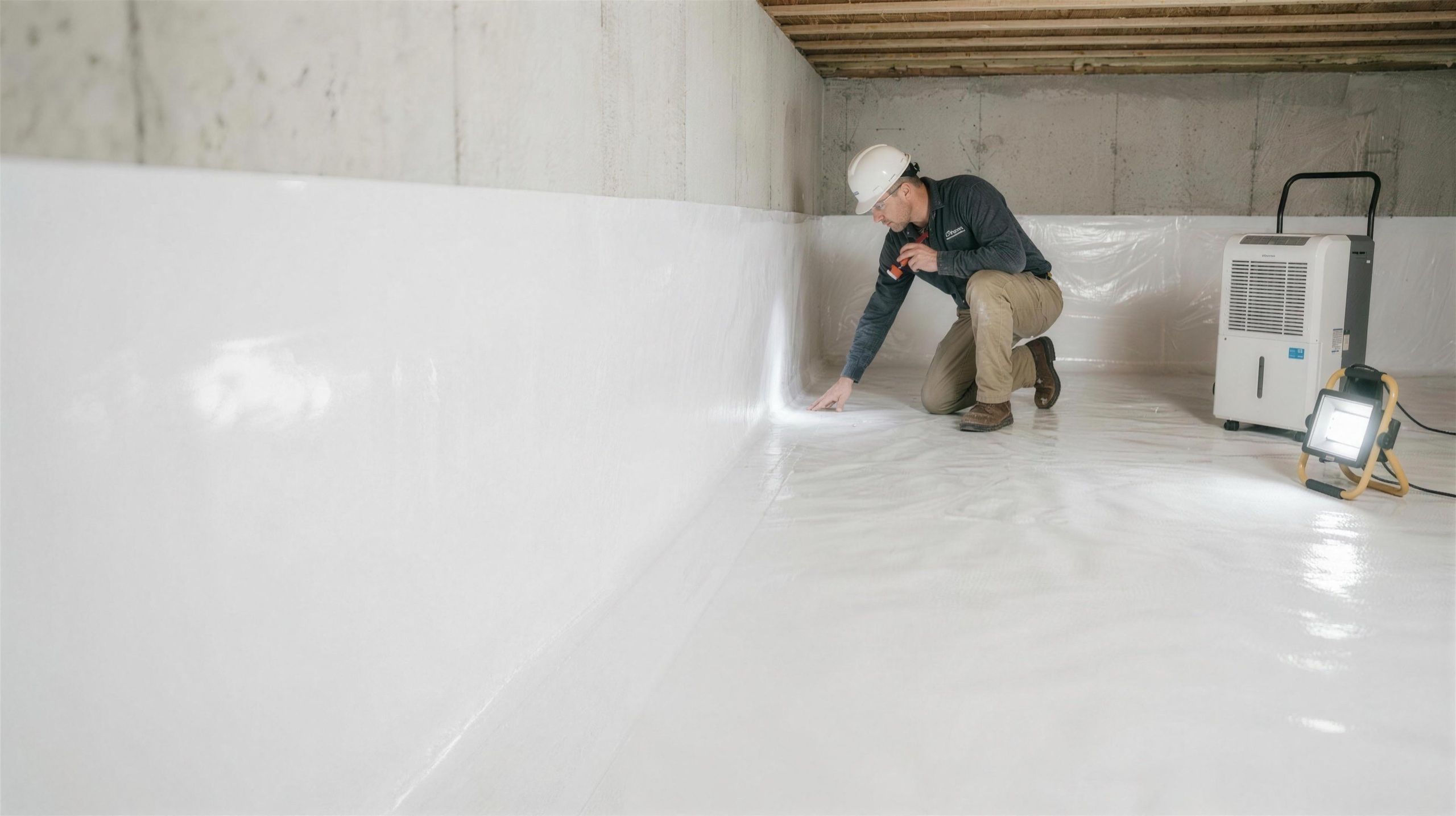
Integration with encapsulation. A dehumidifier in an open, vented crawlspace works significantly harder and less effectively than one in a sealed, encapsulated crawlspace. If your crawlspace has open foundation vents and no liner, the dehumidifier alone is fighting a losing battle in summer. The most effective setup pairs a properly encapsulated crawlspace with an appropriately sized dehumidifier — the encapsulation reduces the moisture load dramatically, and the dehumidifier manages what remains.

When You Need More Than a Dehumidifier

A dehumidifier addresses airborne moisture — it doesn't fix the conditions that are causing that moisture in the first place. There are situations where installing a dehumidifier is the right move, and situations where it treats a symptom while a more significant problem goes unaddressed.

If your crawlspace has standing water after rain events, a dehumidifier won't solve that. Standing water means you have a drainage or grading problem that needs to be fixed at the source — downspout extensions, grade correction, or interior perimeter drainage — before a dehumidifier is relevant. Running a dehumidifier in a crawlspace with active water intrusion will destroy the unit within one or two seasons.

If your crawlspace has visible mold growth on floor joists or subfloor material, installing a dehumidifier without first remediating the mold seals the problem in. The correct sequence is: identify and fix the moisture source, remediate existing mold, encapsulate the crawlspace, then install the dehumidifier as the final layer of moisture management. Skipping steps in that sequence is how people spend money twice. Our mold remediation team handles the remediation side before we install encapsulation and dehumidification systems.

If your crawlspace has a code-minimum 6-mil poly vapor barrier but no wall liner and open vents, a dehumidifier will help but won't get humidity levels to target during summer. The barrier reduces ground vapor transmission but doesn't stop the humid outdoor air coming in through vents from condensing on cooler surfaces. Full encapsulation — sealed walls, closed vents, and a dehumidifier — is the system that achieves and maintains target humidity consistently.

Maintenance: What Keeps a Dehumidifier Running Effectively

A crawlspace dehumidifier is a mechanical appliance operating in a challenging environment. Without basic maintenance, performance degrades and lifespan shortens significantly.

Filter cleaning. Most crawlspace dehumidifiers have an air filter that should be cleaned every one to three months, depending on the dust load in the crawlspace. A clogged filter restricts airflow through the coils, reduces moisture removal capacity, and causes the unit to work harder and run hotter. Check it seasonally at minimum — monthly during peak summer operation.

Condensate line inspection. Check the condensate drain line annually for blockages, kinks, or disconnects. A blocked condensate line will cause water to back up into the unit or overflow the drain pan. At best this trips the overflow shutoff; at worst it damages the unit or deposits water in the crawlspace.

Coil inspection. The evaporator coils should be visually inspected annually for dust buildup, biological growth, or physical damage. Dirty coils reduce efficiency significantly. If you see visible growth on the coils, have the unit serviced before the next cooling season.

Humidity verification. Once or twice a year, verify that the crawlspace is actually maintaining target humidity by checking with a separate calibrated hygrometer rather than relying solely on the unit's built-in display. Unit displays can drift over time. If the crawlspace is consistently reading above 55 to 60 percent despite the unit running, it may be undersized for current conditions or in need of service.

Frequently Asked Questions

How much does crawlspace dehumidifier installation cost in Fort Mill or Charlotte?
A commercial-grade crawlspace dehumidifier with proper installation — including condensate drainage, electrical work if needed, and placement for effective coverage — typically runs $1,200 to $2,000 depending on unit capacity and site conditions. This is significantly more than a hardware store unit, but the performance difference is substantial. A properly sized and installed unit will last 8 to 12 years with basic maintenance. Most hardware store units installed in crawlspaces fail within two to three years.

Do I need encapsulation before installing a dehumidifier?
Not always — but the combination performs significantly better than either alone. If your crawlspace has open vents and no wall liner, a dehumidifier will run continuously during summer and still struggle to maintain 50 percent relative humidity. Encapsulation first, then dehumidifier, is the most effective and most cost-efficient sequence in this climate.

How do I know if my crawlspace humidity is too high?
Signs include a musty smell in the living space (particularly noticeable in summer), soft spots in hardwood or laminate flooring, condensation on pipes or HVAC equipment in the crawlspace, visible mold on floor joists when inspected, or a humidity reading above 60 percent in the crawlspace. Any of these warrants a professional assessment before installing equipment.

Can I install a crawlspace dehumidifier myself?
The unit itself can be placed by a homeowner, but proper installation — including continuous condensate drainage, correct placement, electrical work, and integration with any encapsulation system — benefits from professional installation. An improperly installed unit that drains into a bucket, sits in a blocked corner, or runs on a shared circuit won't perform as designed.

How often should a crawlspace dehumidifier run?
In a properly encapsulated crawlspace in this climate, a well-sized unit will cycle on and off as needed to maintain target humidity — running more frequently in summer, less in winter. If your unit runs continuously without the crawlspace reaching target humidity, it's either undersized, the crawlspace has an active moisture intrusion issue, or the encapsulation has a breach. Any of these warrants investigation before assuming the unit is at fault.


We serve Fort Mill, Rock Hill, Indian Land, Tega Cay, Charlotte, Pineville, Waxhaw, and the surrounding areas 24 hours a day, 7 days a week.

Carolina Pro Restoration LLC is a water damage restoration company serving Fort Mill SC, Rock Hill, Indian Land, Tega Cay, and the greater Charlotte area. We specialize in water damage restoration , mold remediation , crawlspace encapsulation , sewage cleanup , and full property rebuild. IICRC certified. Available 24/7. Direct insurance billing through Xactimate.

You might also like

Official Carolina Pro Restoration Blog

Water damage restoration technician responding to a flooded home in Matthews NC
By Mateo Alvarez March 18, 2026
Dealing with water damage in Matthews NC? Learn what to do in the first hour, what restoration costs, and how Carolina Pro Restoration responds 24/7 across Mecklenburg County.
 File a Water Damage Insurance Claim in South Carolina
By John Varnedore March 15, 2026
Step-by-step guide for Fort Mill & Rock Hill homeowners. What's covered, how to document damage, and how Carolina Pro Restoration handles the claims process for you.
A FLIR E5 thermal camera displays a colorful heat map of a dark floor, highlighting a cool, dark blue area near a wall.
By John Varnedore March 15, 2026
Fort Mill homeowners often miss these 7 warning signs of hidden water damage. Carolina Pro Restoration explains what to look for and when to call.